Search engines decide how visible your content becomes online, and SEO is the system that helps you earn that visibility. Over the years, SEO has moved from simple keyword placement to a more complex mix of content quality, user intent, technical performance, and authority building. Now, artificial intelligence is changing how all of this works by making data faster to process and easier to act on. AI can support research, writing, and optimization, but it also creates a risk if it is used without direction or oversight. The key is not to replace human judgment but to strengthen it with better information and faster workflows.
AI in SEO is becoming more common because search data is growing too large for manual analysis alone. A widely cited industry report by McKinsey estimates that generative AI could add up to 4.4 trillion dollars annually to the global economy, with marketing and sales being among the most affected functions. This shows how deeply AI is expected to influence digital workflows, including SEO. Even with this shift, strategy, brand positioning, and content quality still depend on human control. AI works best when it is treated as an assistant rather than a decision maker.
Key Takeaways
- AI improves speed and accuracy in SEO tasks like keyword research and content analysis
- It helps identify patterns in search behavior that are difficult to detect manually
- Human input is still required for strategy, tone, and content quality control
- AI works best when combined with traditional SEO practices and editorial judgment
- The right tools can improve efficiency without reducing creative control
The Growing Role of AI in SEO
AI is now integrated into many parts of the SEO process and is changing how marketers approach content planning and optimization. Earlier, SEO relied heavily on manual research, intuition, and experience. Today, AI systems can process large volumes of search data in seconds and highlight patterns that help guide decisions more efficiently.
One of the biggest changes is in keyword research and search intent analysis. AI tools do not just suggest keywords but also group them based on meaning and user intent. This allows SEO professionals to build more structured content strategies that match how users actually search. It reduces guesswork and improves targeting accuracy when done correctly.
AI also supports content development by identifying trending topics and gaps in existing content. It can analyze what competitors are publishing and highlight areas where your content can offer more depth or clarity. However, it cannot replace original thinking or brand voice, which still need human input to remain effective and trustworthy.
Using AI SEO Tools Effectively
AI SEO tools are designed to reduce manual workload and improve decision-making. They help with keyword research, on-page optimization, and technical audits, but they still require human review to ensure accuracy and relevance. When used properly, they can significantly improve productivity without removing control from the SEO process.
How AI supports key SEO tasks
| SEO Area | What AI Does | Human Responsibility |
| Keyword Research | Finds related and long-tail keywords based on data patterns | Selects keywords aligned with business goals |
| Content Planning | Suggests topics based on search trends | Builds content strategy and outlines |
| On-Page SEO | Recommends titles, headings, and meta descriptions | Final edits and brand tone control |
| Technical SEO | Detects site issues like broken links or missing tags | Prioritizes fixes and implementation |
| Performance Tracking | Monitors rankings and traffic changes | Interprets data and adjusts strategy |
This combination works best when AI is used for data processing, and humans focus on interpretation and decision-making. It prevents over-reliance on automation and keeps SEO aligned with real business goals. It also ensures that insights generated by AI are applied with context, judgment, and strategic thinking rather than blindly followed.
Integrating AI with Traditional SEO Techniques
Traditional SEO methods remain essential, even with AI support. AI can process information faster, but it cannot fully understand brand identity, customer psychology, or long-term content direction. This is why integration between AI and human strategy is important for consistent results.
AI can help identify keyword gaps and content opportunities, but humans decide how to structure that content into a meaningful narrative. It can also suggest internal linking structures, but editorial judgment ensures that links feel natural and useful for readers. This balance helps maintain both SEO performance and content quality.
In link building, AI can find potential websites for outreach by analyzing relevance and authority. However, relationship building and communication still depend on human effort. This ensures that backlinks are not just data points but real connections that support long-term SEO growth.
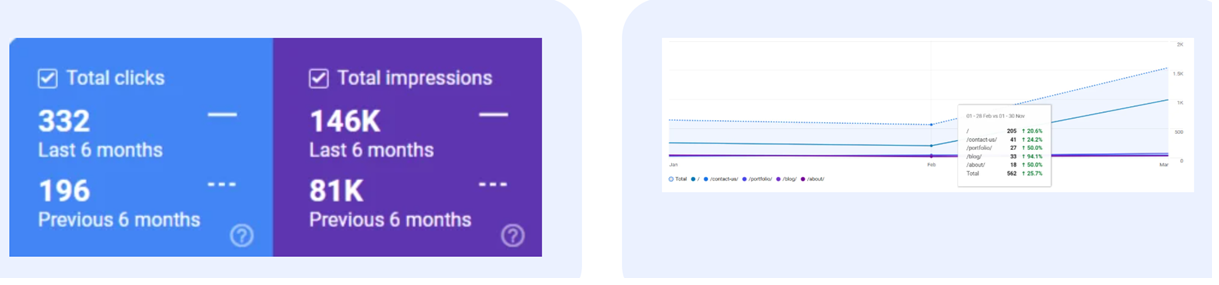
ITVibes helped Knepper Enterprises improve SEO performance through technical optimization, content strategy, and user-focused website improvements.
AI can improve efficiency, but long-term SEO growth still depends on strategy and execution. ITVibes demonstrated this with Knepper Enterprises by combining SEO content writing, technical optimization, branding, and user-focused website improvements, resulting in a 59% increase in clicks and a 55% increase in impressions
Building a Smarter SEO Strategy with AI
AI helps move SEO from reactive work to proactive planning. Instead of waiting for rankings to drop or traffic to decline, AI tools can track patterns early and highlight changes in user behavior. This allows SEO teams to adjust content and technical elements before problems grow larger.
AI also improves alignment between SEO and business goals. Analyzing user behavior and conversion data, it helps identify which pages drive real value instead of just traffic. This makes SEO more focused on outcomes rather than vanity metrics like impressions or keyword rankings alone.
Control remains important in this process because AI suggestions are based on patterns, not context. Business priorities, seasonal changes, and brand positioning still require human decision-making. When both are combined, SEO becomes more strategic and less dependent on trial and error. Even technical issues like orphan pages show how structure and internal connectivity impact performance, which is why SEO systems need both automation and manual oversight
Choosing the Right AI SEO Tools
Selecting AI tools requires careful evaluation because not all tools serve the same purpose. Some focus on content optimization, while others are designed for technical SEO or analytics. The right choice depends on your workflow and long-term goals.
Key Evaluation Factors
| Factor | What to Evaluate |
| Usability | Simple interface that reduces learning time |
| Data Quality | Accuracy of keyword and traffic insights |
| Integration | Compatibility with CMS and SEO platforms |
| Scalability | Ability to support growing content needs |
| Cost Efficiency | Balance between features and pricing |
Choosing tools based on clarity and usefulness is more important than choosing based on popularity. The goal is to improve workflow efficiency without adding unnecessary complexity. The right tools should simplify your SEO process and help your team focus on meaningful work instead of managing complicated systems.
Common Mistakes When Using AI in SEO
AI can improve SEO performance, but misuse can reduce content quality and weaken strategy. One common mistake is publishing AI-generated content without proper editing or fact-checking. This can lead to content that lacks clarity, accuracy, or originality.
Another mistake is:
- Relying too heavily on keyword suggestions without understanding search intent
- Ignoring user behavior and focusing only on volume-based keywords
- Publishing content that does not match the brand voice or tone
- Treating AI-generated drafts as final content without refinement
- Skipping human review and fact-checking before publishing
SEO teams should also avoid treating AI outputs as final decisions. AI provides recommendations, not strategy. Human review is necessary to ensure alignment with business goals and audience expectations.
AI for SEO FAQs
How can AI help improve SEO performance?
AI helps improve SEO by speeding up tasks like keyword research, content analysis, technical audits, and performance tracking. It can process large amounts of search data quickly and identify patterns that may be difficult to detect manually. However, AI works best when combined with human strategy and editorial review to ensure content quality and business alignment.
Can AI completely replace human SEO experts?
AI cannot fully replace human SEO experts because strategy, creativity, and decision-making still require human judgment. While AI can automate repetitive tasks and provide recommendations, it does not fully understand brand identity, audience psychology, or long-term business goals. Human oversight is necessary to make sure SEO efforts remain accurate, relevant, and aligned with user expectations.
What are the risks of using AI for SEO?
One major risk is over-relying on AI-generated content without proper editing or fact-checking. This can result in generic, inaccurate, or low-quality content that does not provide real value to users. Businesses may also lose consistency in brand voice if AI outputs are published without human refinement and strategic direction.
What should businesses look for in AI SEO tools?
Businesses should look for AI SEO tools that are easy to use, provide accurate data insights, and integrate well with existing systems. Scalability and cost-effectiveness are also important because SEO needs can grow over time. The best tools should simplify workflows and support decision-making instead of adding unnecessary complexity.
Is combining AI with traditional SEO important?
Yes, combining AI with traditional SEO methods is important for maintaining a balance between automation and strategy. AI can improve efficiency by analyzing data and identifying opportunities, while traditional SEO practices ensure content remains user-focused and aligned with search intent. This combination helps businesses create stronger SEO strategies that support both rankings and long-term growth.
Use AI to Improve SEO Without Losing Human Control
AI tools can make SEO faster and more efficient, but automation alone does not create a strong strategy. Search engines now evaluate content quality, user intent, technical performance, and overall user experience more carefully than ever before. While AI can process large amounts of data and identify patterns quickly, it still cannot replace human judgment, creativity, or strategic thinking. Businesses that rely too heavily on automation often risk publishing generic content, missing user intent, or losing consistency in brand voice. Before adding more AI tools to your workflow, it is important to build a system where technology supports your strategy instead of controlling it.
As a digital marketing partner, ITVibes helps businesses use AI in SEO while maintaining quality, structure, and long-term strategy. Our team focuses on content optimization, technical SEO, keyword strategy, and performance analysis to make sure automation improves efficiency without sacrificing control. We combine AI-driven insights with human expertise, so your SEO strategy remains accurate, user-focused, and aligned with your business goals.
Ready to build a smarter SEO strategy with AI? Contact us today to improve your SEO workflow, strengthen your content strategy, and create a balanced approach that combines automation with real human expertise.

Sabeeha Banu is a Content Writer at ITVibes, Inc., focused on writing clear and engaging content. She holds a Bachelor’s degree in Computer Science and brings a practical yet creative approach to her work. A lifelong learner and poet at heart, she enjoys crafting simple, meaningful stories inspired by everyday moments.